

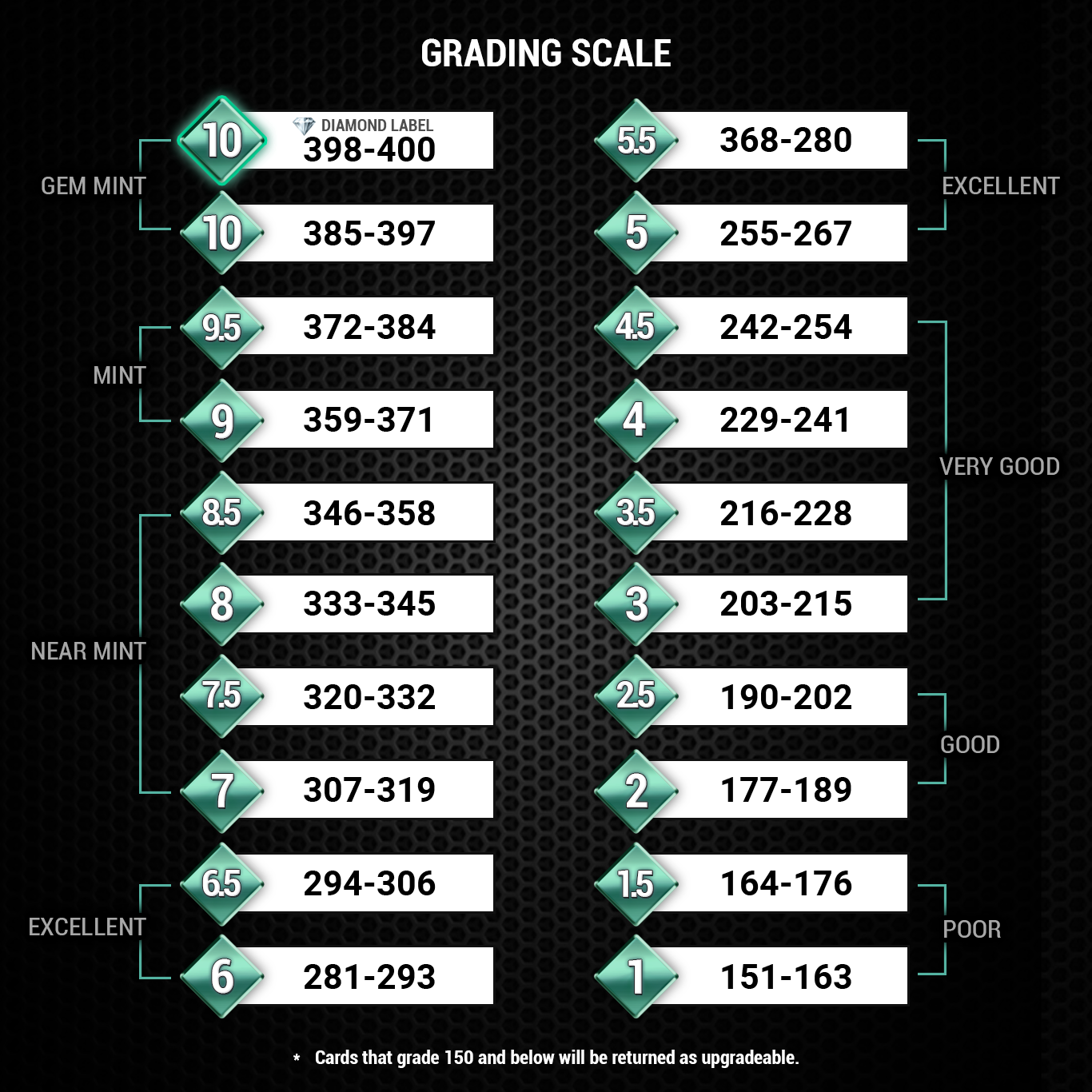
Our grading system uses a 1–10 scale with half-point increments (0.5). This approach removes ambiguity by eliminating “tweeners” and ensures that every Grade is as consistent and accurate as possible.
Cards that achieve a flawless evaluation are awarded our Diamond Label, a special designation reserved for the true “Grail” pieces in your collection.
Grades are determined using four categories, or subgrades: Corners, Edges, Centering, and Surface.
Each category is assigned a numerical score from 1 to 100 based on condition. The four scores are then combined, and the total determines the final grade according to the scale below.
All certifications will be accessible through our website or app and will include:
Card Information, Final Grade, Subgrades, and Grader Notes.
Mint Authentication will not grade any card that shows signs of trimming, recoloring, soaking, polishing, pressing, or any other form of alteration or tampering. Any card determined to have been materially modified whether by the addition to or removal from its original manufacturer issued condition (including but not limited to cards from factory packaging) will be deemed questionable in authenticity and ineligible for grading.
If a card is returned ungraded and not sealed in a holder, it will be labeled with one or more of the following UG (Ungradeable) codes, explaining the reason(s) it could not be graded. In such cases, the card will be returned, and grading fees will still apply.
Ungradeable (UG) Codes
UG1 – Below Grading Threshold
The card does not meet the minimum requirement of 150 points on our 400-point grading scale.
UG2 – Authentication
After thorough research and verification, we were unable to confirm the card as real, genuine, and consistent with its original manufacturer specifications. This does not definitively mean the card is “fake,” but rather that its authenticity could not be verified based on the available information.
UG3 – Cleaning or Polishing
There is evidence of substances or techniques used to clean, soak, saturate, polish, or fill in surface damage whether on the front, back, or edges of the card. Such findings disqualify the card from grading under Mint Authentication’s policies.
UG4 – Cutting or Trimming
The card shows signs of having been cut or trimmed using scissors, blades, or other tools. Such alterations are typically done to enhance edges, corners, or centering and are considered tampering.
UG5 – Pressing or Tooling
Tools or presses may have been used to remove wrinkles, creases, or folds to improve visual appearance. These treatments often alter the card’s size or thickness, making it fall outside the original manufacturer’s specifications.